Bio-Energie Moser selects Nordsol technology for bio-LNG expansion
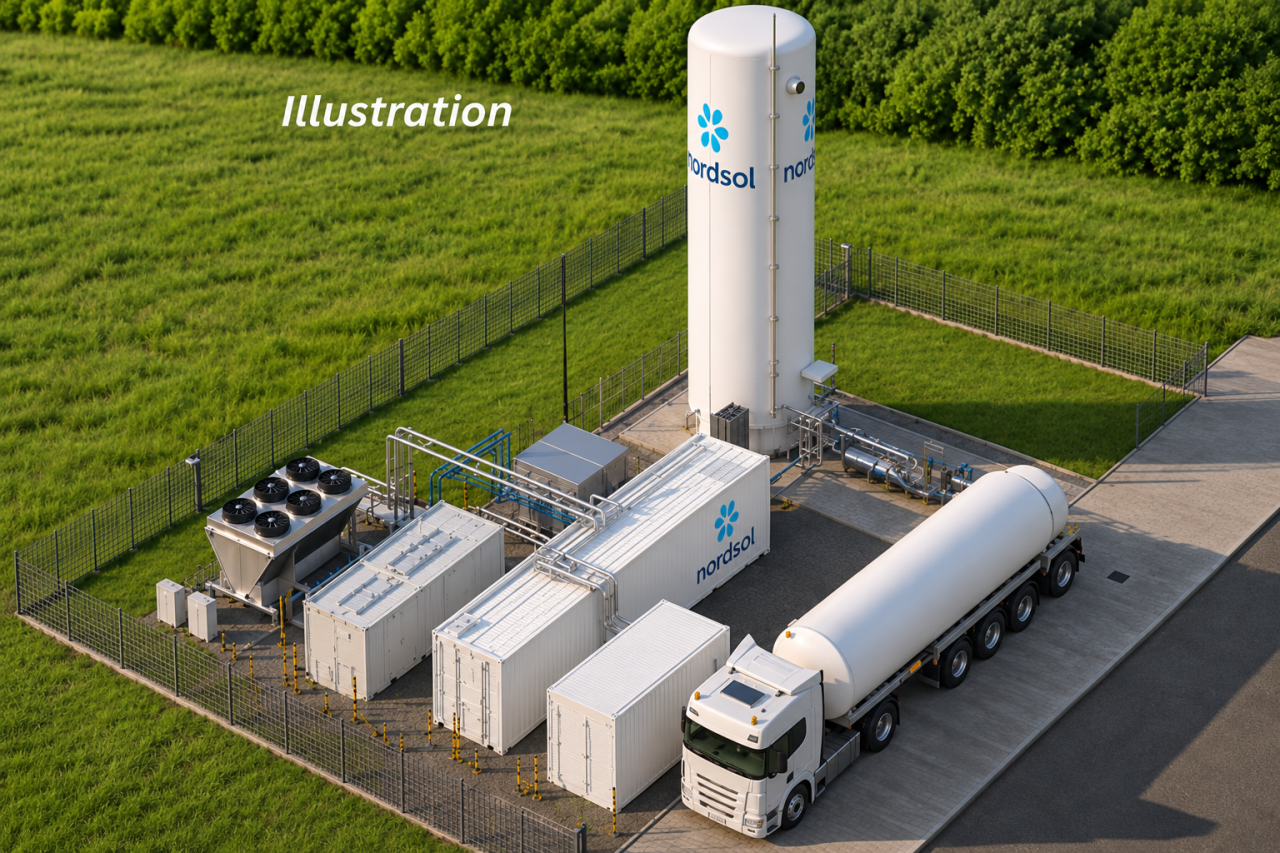
Illustration of a Nordsol Compact bio-LNG production installation
Article details
Published 3 November 2026
Updated 3 November 2026
Key takeaways

Doubling Bio-Energie Moser’s manure-based bio-LNG output

  • First Nordsol plant in Germany: Bio-Energie Moser selects Nordsol to expand bio-LNG production in Feldkirchen-Westerham, Bavaria.
  • Site capacity doubles to 12 tonnes per day: the new plant adds 6 tonnes of bio-LNG daily from manure-based biogas.
  • Production starts in Q4 2027, supplying regional road transport with around 30 GWh of renewable fuel per year.
  • First integration with PSA upgrading: Nordsol’s liquefaction technology connects to an ETW pressure swing adsorption unit for the first time.
Introduction
Dutch technology company Nordsol has been selected by Bio-Energie Moser to deliver a bio-LNG production plant in Feldkirchen-Westerham, Bavaria. It will be the first plant Nordsol delivers in Germany. The plant will double Moser's existing bio-LNG production by converting biogas, produced on site from manure, into high-quality bio-LNG for road transport companies in the region.

01 Doubling production capacity in Q4 2027

Bio-LNG production with the new plant is scheduled to start in Q4 2027. The Nordsol plant will add 6 tonnes of bio-LNG per day, bringing the site’s total capacity to 12 tonnes per day. The expansion corresponds to approximately 1.2 MWel of biogas capacity and around 30 GWh of renewable fuel per year.

“Producing bio-LNG has shown us that there is steady demand from transport companies in our region. For the next step, we were looking for a partner with proven liquefaction technology. Nordsol’s track record and the know-how of its team convinced us,” says Leonhard Moser of Bio-Energie Moser.

02 Efficient, decentralised bio‑LNG production

At the heart of the new facility is Nordsol’s proprietary liquefaction technology, designed for decentralised and small-scale applications. At Moser, Nordsol’s system will be connected to a biogas upgrading unit based on pressure swing adsorption (PSA) technology from ETW. It is the first time Nordsol integrates its liquefaction technology with PSA upgrading.

“Delivering our first plant in Germany is a milestone for Nordsol,” says Léon van Bossum, CEO at Nordsol. “Bio-Energie Moser already knows bio-LNG production from the inside, and we are proud that they have chosen our technology for their expansion.”

03 A new route for German biogas producers

With nearly 10,000 biogas plants, Germany has one of Europe’s largest biogas sectors. Many of these plants are looking for new ways to market their gas as their current feed-in tariffs under the EEG come to an end. Converting biogas into bio-LNG gives producers direct access to the transport fuel market.

Nordsol’s first German plant builds on its track record across Europe. Nordsol-built plants are operational in the Netherlands, the United Kingdom and Portugal, with further installations under construction in the United Kingdom, Switzerland, Norway and Sweden. Together, Nordsol plants have produced around 20,000 tonnes of bio-LNG to date.

Want to learn more about
this bio‑LNG plant?

Interested in more details about this project and our onsite bio-LNG production technology?
Rob is happy to tell you all about it.

04 About Nordsol

Nordsol is a technology pioneer in on-site production of fossil-free bio-LNG. Its proprietary systems convert biogas from advanced feedstocks, including organic waste streams that are no longer suitable for food, feed or other high-value use, into high-purity bio-LNG for heavy road and maritime transport. With a focus on energy efficiency, reliability and ease of operation, Nordsol’s installations are active across Europe. The company also owns and operates two production sites in the Netherlands.

What will the new plant at Bio-Energie Moser do?
What is new about the technology at Bio-Energie Moser?
Why is bio-LNG relevant for German biogas producers?
Who will use the bio-LNG produced at Moser?
From biogas to bio‑LNG
The scalable pathway to decarbonising transport

Explore the technical and economic roadmap for converting biogas into bio-LNG, including plant integration, scalability, cost structures, and revenue optimization strategies.