- Queen Máxima opens bio-LNG plant in Wilp, converting organic household waste into clean fuel.
- 2,400 tons of bio-LNG produced annually, enough for trucks to cover 10 million kilometers.
- 87,500 tons of CO2 avoided over the next decade, equal to 4 million trees.
- Backed by CINEA’s EU Innovation Fund, confirming European confidence in small-scale, fossil-free bio-LNG production.
- 20,000 biogas plants across Europe could apply this technology, cutting fossil fuel dependency.
Queen Máxima opens innovative
bio-LNG plant in Wilp
Key takeaways
Local waste powers Europe's fossil-free transport.

Summary
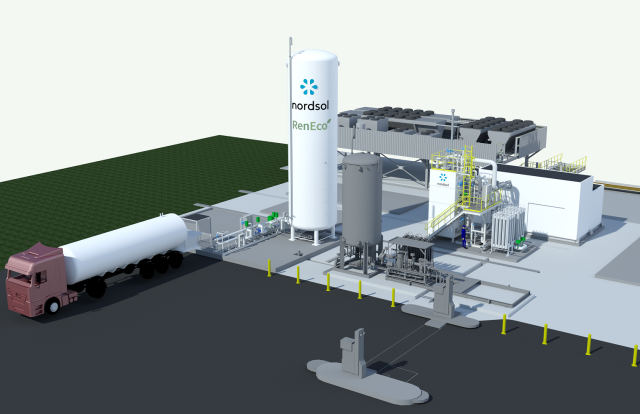
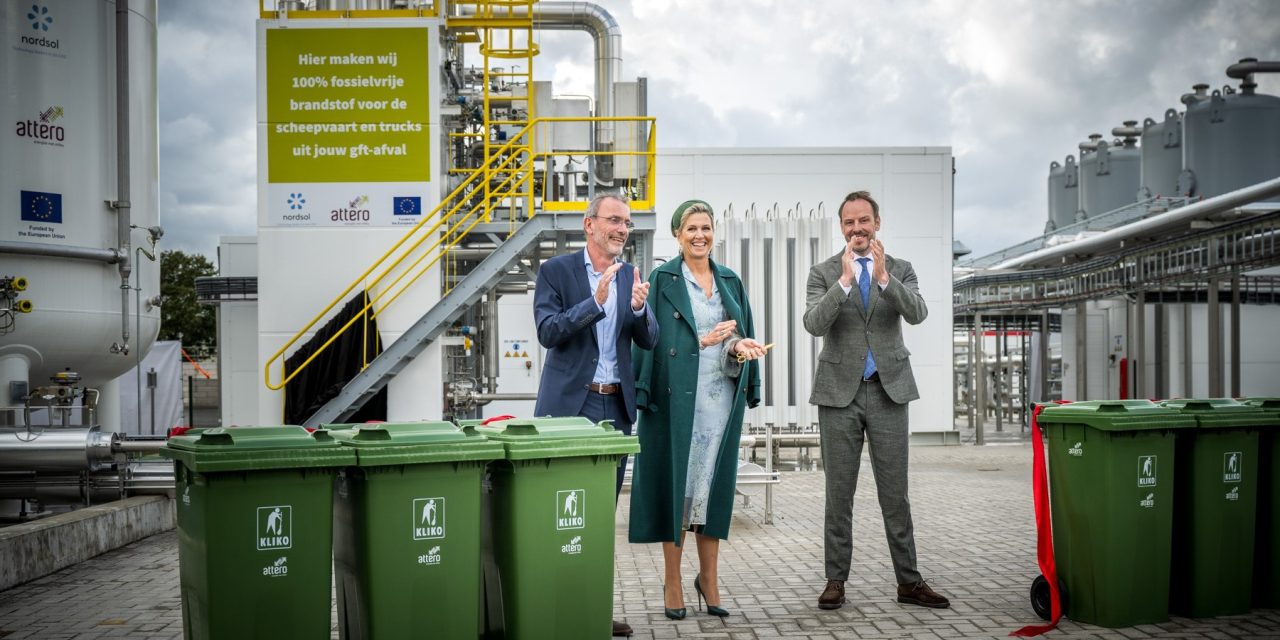
Her Majesty Queen Máxima has officially opened the bio-LNG plant from Attero and Nordsol in Wilp. The facility produces sustainable bio-LNG from biogas generated through the digestion of vegetable, fruit, and garden waste. This marks a significant step towards more sustainable maritime and heavy road transport.

01
About the Plant
The plant will annually convert 6 million Nm3 of biogas from household VFG waste into 2,400 tons of high-purity bio-LNG and 5,000 tons of liquid bio CO2. Based on average consumption, trucks can cover over 10 million kilometers with this amount of bio-LNG. Additionally, the transformation of waste into energy reduces greenhouse gas emissions. Over the next ten years, Attero and Nordsol expect a CO2 emission reduction of 87,500 tons, equivalent to the CO2 absorption of more than 4 million trees.
“We are honored that Queen Máxima has opened our plant,” said John van Haeff, Organic Business Unit Manager at Attero. “This plant proves that waste is a source of clean energy and new raw materials. Together with Nordsol, we are directly contributing to CO2 reduction and promoting the circular economy.”

02
Sustainable Bio‑LNG as a Solution for the Transport Sector
Bio-LNG from fossil-free sources can play a key role in sectors where full electrification is challenging. Especially for heavy freight transport over long distances, as well as shipping and aviation, full electrification is not yet feasible, making the use of renewable fuels crucial. Thanks to the immediate applicability of bio-LNG in the existing infrastructure, it offers a scalable and cost-effective solution.
“With our technology, we produce true bio-LNG, not from fossil sources but from organic waste,” says Léon van Bossum, CEO of Nordsol. “We can already apply this technology to many of the 20,000 biogas plants in Europe, thereby reducing dependence on imported fossil fuels.“

Want to learn more about
this bio‑LNG plant?
this bio‑LNG plant?
Interested in more details about this project and our onsite bio-LNG production technology?
Rob is happy to tell you all about it.

03
The role of bio‑LNG in the EU
In 2021, the European Union granted the project a €4.3 million subsidy. The EU sees a significant role for bio-LNG in making long-distance heavy transport more sustainable. In 2022, the European Parliament passed the FuelEU Maritime Regulation, aimed at gradually reducing the greenhouse gas intensity of fuels in the sector, starting with a 2% reduction by 2025 and increasing to an 80% reduction by 2050. The Attero and Nordsol bio-LNG plant supports the European goals for climate and energy transition.
“The European Commission sees great potential in the Attero and Nordsol bio-LNG plant,” said Daniel Mes, a member of the Cabinet of European Commissioner Wopke Hoekstra. “We are closely following developments with interest and enthusiasm.”

From biogas to bio‑LNG
The scalable pathway to decarbonising transport
The scalable pathway to decarbonising transport
Explore the technical and economic roadmap for converting biogas into bio-LNG, including plant integration, scalability, cost structures, and revenue optimization strategies.