King Willem-Alexander opens first Dutch bio-LNG plant
Article details
Published 14 October 2021
Updated 18 October 2021
Key takeaways

A circular chain from waste collection to fuel.

  • First Dutch bio-LNG plant opened by King Willem-Alexander, built by Nordsol in collaboration with Renewi and Shell.
  • Annual production of 3.4 kilotons of bio-LNG, avoiding more than 14.3 kilotons of fossil CO2 emissions per year.
  • Bio-LNG is produced from organic waste, making it compatible with existing LNG engines and infrastructure.
  • Biogenic CO2 is captured and liquefied as a byproduct, available for reuse in greenhouses.
  • The plant demonstrates a replicable model: around 260 biogas plants in the Netherlands could produce bio-LNG using this technology.
Introduction
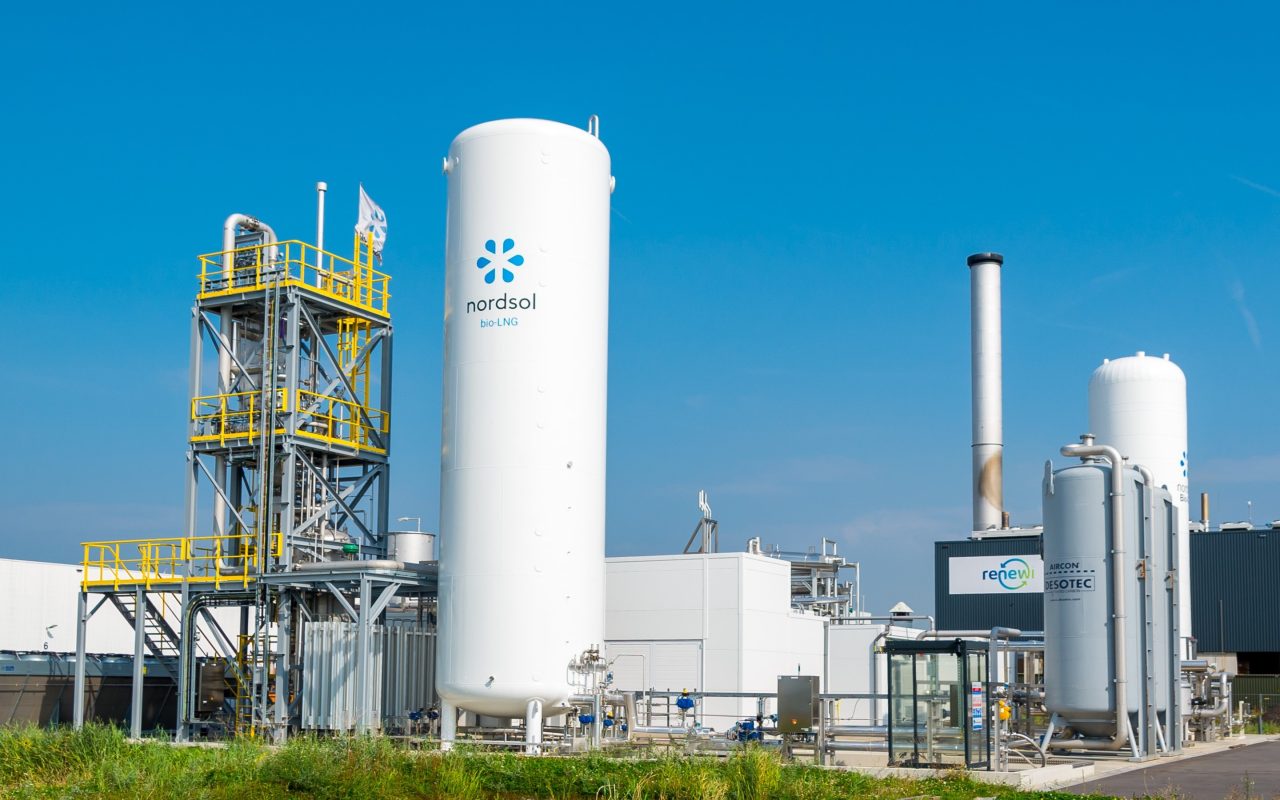
With the press of a button Dutch king Willem-Alexander officially put into service the first bio-LNG plant of the Netherlands today. With this scoop, initiators Nordsol, Renewi and Shell have taken the next step in making road freight transport more sustainable.

01 What is bio‑LNG

Bio-LNG is made from organic waste, not from fossil resources. That is why bio-LNG makes it possible to reduce CO2 emissions in the short term. The fuel also has a lower nitrogen emissions compared to diesel, and cleaner combustion ensures that there is hardly any emission of particulates. Bio-LNG can also be used in existing LNG engines. For storage and distribution, the growing LNG infrastructure in the Netherlands and in the whole of Europe can be used.

“The use of smart, energy-efficient technology is the basis for a local, circular economy and a healthy business case.”  Jerom van Roosmalen, co-founder of Nordsol

02 13 million on‑road kilometers

Nordsol’s bio-LNG plant is built on the site of Renewi in Amsterdam Westpoort. It is expected that the new plant will produce an estimated 3.4 kilotons of bio-LNG per year, preventing the emission of more than 14.3 kilotons of fossil CO₂. This is sufficient for 13 million on-road kilometers.

Want to learn more about
this bio‑LNG plant?

Interested in more details about this project and our onsite bio-LNG production technology?
Rob is happy to tell you all about it.

03 Strong collaboration between initiators

The three initiators each have their own part in the production of biofuel.

Renewi collects organic waste throughout the Netherlands, such as expired products from supermarkets. The recycler then processes the waste and converts it into biogas in its own fermenters. Nordsol’s new bio-LNG plant reprocesses the biogas into bio-LNG. Shell makes this bio-LNG available for its customers at LNG service stations in the Netherlands. In addition, during the production of bio-LNG, CO2 is removed from the biogas and liquefied for reuse in greenhouses.

“Collaboration of partners within the chain leads to concrete results,” said Otto de Bont, CEO of Renewi. “This matches our vision on ‘Waste No More’ and also ties in with our commitment to take the lead in producing secondary raw materials from waste streams. By also using bio-LNG itself when collecting this waste, Renewi closes the circle.”

This bio-LNG plant is in part subsidised by the EU (20 percent), as part of its strategy to decarbonise the road transport.

04 Opportunity for scaling

The Netherlands has approximately 260 ‘traditional’ biogas plants. Most of these can be made suitable for the production of bio-LNG. With the technology used by the biogas plant of Renewi in Amsterdam, bio-LNG can also be produced in many other places in the country.

Marjan van Loon, President Director of Shell Netherlands: “Shell wants to help clients to be more sustainable and makes significant investments in the energy transition. To make this possible, we collaborate with partners like Renewi and Nordsol. Bio-LNG is the next step in making the cargo sector sustainable. Thanks to this collaboration we can offer our customers in the logistics industry a cleaner alternative, starting with road freight transport and, eventually, also maritime transport.”

The partners expect that thanks to the construction of new plants, the available quantity of bio-LNG will, over the next four years, increase at least tenfold.

Frequently Asked Questions Bio‑LNG from waste: your questions answered.
What is the bio-LNG plant in Amsterdam Westpoort?
How much bio-LNG does the plant produce, and what is its climate impact?
What role do Nordsol, Renewi and Shell each play in this project?
Does this plant demonstrate a model that can be replicated across Europe?
From biogas to bio‑LNG
The scalable pathway to decarbonising transport

Explore the technical and economic roadmap for converting biogas into bio-LNG, including plant integration, scalability, cost structures, and revenue optimization strategies.