Nordsol's technology explained
The cooling cycle
Article details
Published 25 October 2024
Updated 3 June 2026
Key take-aways

Smart cooling technology for reliable bio-LNG production

  • Energy consumption drives a significant part of operational costs and impacts the carbon intensity of the biofuel.
  • The reverse Brayton cooling cycle strikes the right balance between energy efficiency and process simplicity for small-scale bio-LNG.
  • Biomethane as refrigerant makes Nordsol’s cooling cycle the most efficient in the required temperature range.
  • Flash cooling eliminates freeze-out risk and cold shocks, enabling smooth, reliable plant operation.
  • The biomethane turbo expander drives the reverse Brayton cooling cycle, delivering both efficiency and operational simplicity in one machine.
Introduction
In a series of technical articles we introduce you to the Nordsol technology for liquefaction of biogas to bio-LNG. This first article discusses the cooling process and in particular the role of the biomethane turbo expander.

01 From biogas to bio‑LNG in two steps

With the Nordsol technology, bio-LNG is produced from biogas in just two steps. In the gas treatment step, the biomethane in the biogas is separated from other components, such as CO2. With our patented Flash-2-Sweep technology we only need membranes to produce biomethane pure enough to liquefy. This technology is described in a this article.


02 Energy consumption

In the biomethane liquefaction step, the temperature drops to a level between -145°C and -160°C, depending on customer needs. Several refrigeration technologies can do this, each with its own operational challenges, efficiency and complexity.

Energy consumption determines a significant part of the operational costs and impacts the carbon intensity of the biofuel. But, small-scale bio-LNG production also requires a compact installation and an easy-to-control, preferably unmanned process. Therefore, the right balance between energy efficiency and process manageability is key for the economic viability of a bio-LNG plant.

03 Choice of the refrigeration cycle

The following basic refrigeration cycles for bio-LNG can be distinguished, listed in increasing order of complexity and energy efficiency.

    1. Liquid nitrogen (LIN) open-cycle
    2. Stirling cycle
    3. Linde cycle
    4. Reverse Brayton cycle
    5. Mixed Refrigerant (MR) cycle
    6. Cascade, mixed fluid or pure component cycles

These processes have many variants and permutations, but they can all be categorised according to the six groups mentioned above. To approach a theoretically perfect thermodynamic process, a highly complex and costly installation would be necessary. Therefore, Nordsol has designed its biomethane liquefaction process based on the reverse Brayton cycle, which is a good compromise between efficiency and complexity.
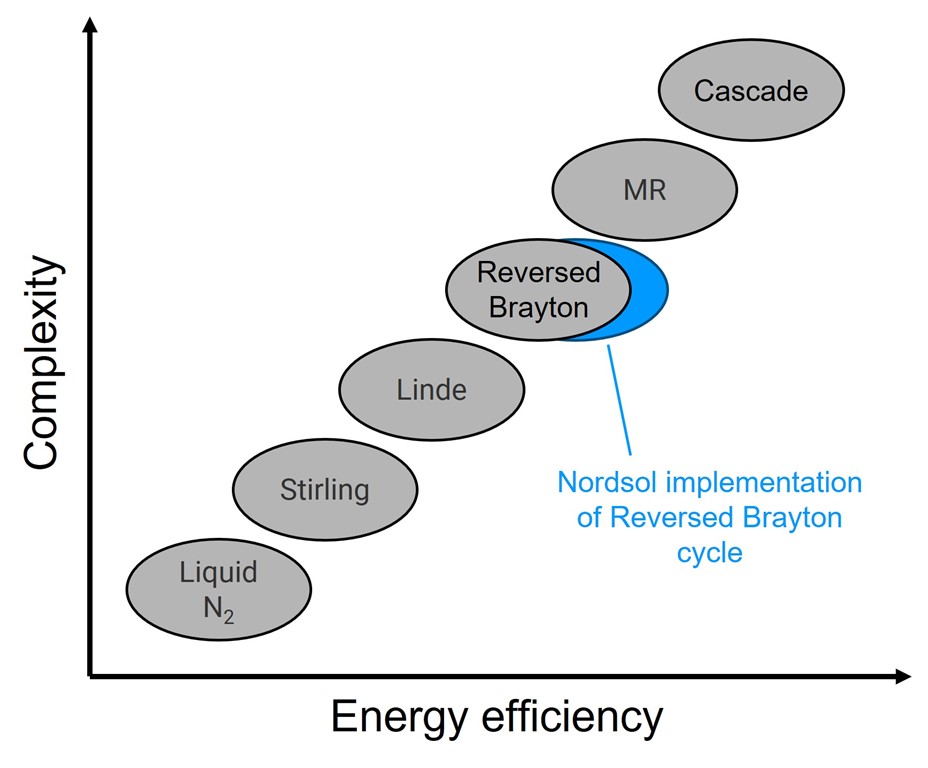
 

04 Nordsol implementation of the reverse Brayton cycle

Our reverse Brayton cycle is based on methane gas expansion through a single turbo expander and is a simplified version of the efficient AP-C1 process developed by Air Products. This market leader in LNG has demonstrated that gas expansion cycles with flash cooling can provide significant power savings.

In addition, Nordsol uses biomethane as the refrigerant, rather than nitrogen. This makes it the most efficient reverse Brayton cycle in the required temperature range.

But, our implementation of the reverse Brayton cycle with flash cooling also offers other important advantages besides energy efficiency.

  • Reduced risk of freeze-out – Sub-cooling to a low temperature (-160°C) in a heat exchanger carries the risk of local freeze-out during transients and brief upsets (e.g. increased CO₂ concentrations). This risk is significantly reduced in a gas expansion – flash cooling process with a relatively high temperature (-120°C) of the heat exchanger.
  • Smooth cooldown – Cold shocks are very common with liquid LNG or liquid Mixed Refrigerant (MR) in heat exchangers. Longer-term, they can result in leaks in heat exchangers due to thermal fatigue. Since there are no liquids in the heat exchanger in the iLNG process, there is no risk of cold shocks, no liquid mal-distribution (unbalanced cooling) nor any risk of thermal fatigue.
  • Integration with Boil-Off Gas – Low-pressure flash gas, combined with boil-off gas (BOG) from the tank and return gas from truck loading, serves as the sweep gas for the membranes in the biogas treatment step. The gas is recycled to the biogas compressor, which now combines several functions into one efficient machine: biogas compressor as well as BOG, flash gas, and truck return gas compressor.
  • Simplified startup procedure – During the startup, sub-cooling is initially not possible since there is no liquid. The cooldown procedure of a gas expansion – flash process is easier and faster, with the option to recycle a relatively large flow of flash gas during a steady, well-controlled equipment cooldown.
05 The biomethane turbo expander

The unique Nordsol application of the turbo expander, equipped with foil bearings and with methane as the refrigerant, further improves the simplicity and efficiency of the reverse Brayton cycle process in the required temperature range, compared to the nitrogen expander.

The turbo expander running at 60,000 rpm is derived from so-called air cycle (air conditioning) machines in commercial aircraft, like Boeing 777. These Air Cycle Machines (ACM) operate on air and are very reliable, robust, capable of performing 1000’s of start-stops and based on ‘simple’, robust gas foil bearings.

The biomethane turbo expander with foil bearings is currently running at high efficiency, reliably, 24/7 at Nordsol’s own bio-LNG plant in Amsterdam.

The Nordsol implementation of the reverse Brayton cooling cycle, combined with flash cooling, biomethane as the refrigerant, and a biomethane turbo expander, combines the best of two worlds: low equipment count, low refrigerant inventory, easy to operate while maintaining a high efficiency.

06 Frequently Asked Questions
Why does energy efficiency matter in bio-LNG production?
Why did Nordsol choose the reverse Brayton cycle for liquefaction?
Why does Nordsol use biomethane as a refrigerant?
How does flash cooling improve plant reliability?
What role does the turbo expander play in Nordsol's cooling cycle?
About this author Michiel van Aken

Michiel is devoted to the development of sustainable biofuels, e-fuels and new process routes for biogenic CO2. He's an expert in Gas & LNG plant design and operation, (co)-author of 14 patents, and very committed to share his in-depth knowledge.